AI, AI, AI, AI, AI, AI, AI, AI was a good YearAI!

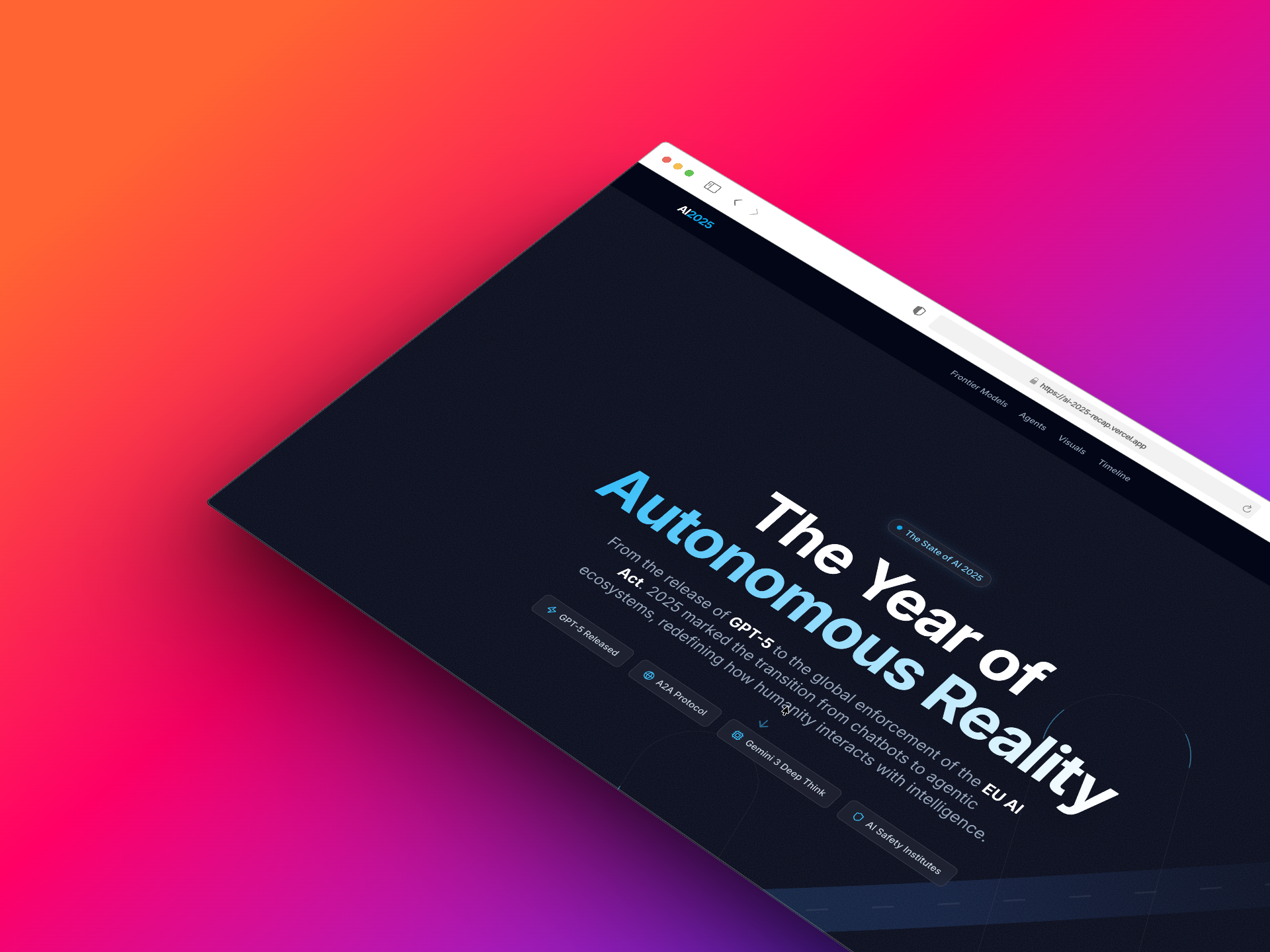
How 2025 Became the Year Artificial Intelligence Grew Up
In the beginning, there were chatbots. And on the seventh quarter, we looked upon what we had built, and behold it was autonomous, it was reasoning, it was everywhere. 2025 was not just another year in AI; it was the inflection point, the pivot year, the moment when artificial intelligence stopped being a tool and became an ecosystem. This was the year AI grew up.
If you have been following the breathless pace of AI development, you know the headlines have been relentless. But 2025 was fundamentally different. This was the year we crossed thresholds we had been promised for decades. This was the year AI became genuinely autonomous, genuinely productive, and genuinely everywhere.
The Great Awakening: When Machines Learned to Think
The technical ascent in 2025 marked a decisive leap from sophisticated tools to entities capable of genuine independent reasoning. The performance ceiling for foundation models reached new frontiers, and the results spoke louder than any marketing copy ever could.
The year opened with a bombshell. In January, DeepSeek released R1, a model that matched the reasoning capabilities of OpenAI o1 at a fraction of the cost—literally one-tenth the inference expense. The market reaction was immediate and brutal: Nvidia shed $600 billion in market capitalization in a single day. The scaling laws narrative—the comfortable assumption that bigger always equals better—faced its first serious existential challenge.
This was not the only seismic shift. Throughout the year, the flagship releases kept coming, each pushing boundaries in logical consistency and context management:
- GPT-5 (Orion): Launched August 7, evolved from o1 using massive test-time compute to solve novel architecture problems
- Claude 4.1: Released August 5, showing remarkable advances in coding agents and complex reasoning tasks
- Grok 5: Arrived July 9, marking a significant entry into the reasoning model wars
- DeepSeek R1: The cost efficiency disruptor, proving that high performance does not require deep pockets
- Gemini 3 Pro: Delivered an unprecedented 2M token context window for entire-repository analysis
We crossed a threshold that had seemed theoretical just months before: AI could now handle 70+ percent of GitHub issues automatically—tasks that previously required junior developers. This was not incremental progress. This was a phase transition, a fundamental shift in what machines could do.
The Speed Revolution: When AI Learned to See
The generative AI revolution extended far beyond text. The visual intelligence race of 2025 redefined what we thought was possible with image generation, and it came down to a fundamental choice: speed versus quality.
Google Nano Banana defined the speed frontier with generation times of just 0.18 seconds—fast enough for real-time UI asset creation during live design sessions. OpenAI countered with GPT Images 1.5 in December, trading 70 milliseconds for native vector and SVG output, enabling crisp graphics at any scale. Gemini 3 Pro pushed in another direction entirely: fidelity. Native 4K resolution with Deep Grounding, using Google Search to verify object details before generation.
The battle lines were drawn: speed versus quality. But by the end of the year, we had both. And that changed everything.
Vibe Coding: When English Became Programming
Andrej Karpathy, former AI director at Tesla, captured the paradigm shift perfectly with his now-famous quote: The compiler is the LLM. The syntax is English. The skill is taste. This was not mere hyperbole—it was an accurate description of how software development fundamentally transformed in 2025.
Context-aware IDEs like Cursor and Windsurf transformed development from syntax manipulation to intent expression. Replit Agent took this further, enabling ideas to become deployed applications in minutes. The velocity gains were staggering:
- 40 percent increase in new developers entering the field—the barrier to entry collapsed
- 100x velocity improvements in certain workflows—what took days now took minutes
- Effectively zero syntax errors—machines do not forget semicolons
But beneath the celebration lurked an uncomfortable truth. While 99 percent of developers adopted AI-assisted coding, only 18 percent of teams could secure code at generation speed. We created what researchers called the Security Debt Spiral—generating vulnerabilities faster than humans could possibly mitigate them. We had learned to build at machine speed, but we still debugged and secured at human speed.
The Protocol Wars: The Battle for the Agentic Future
2025 marked AI escaping from the chat box. This was the year agents stopped being confined to conversational interfaces and began operating in the wild, interacting with tools, systems, and each other. Two competing standards emerged to orchestrate this new agentic web.
Model Context Protocol (MCP), championed by Anthropic and AWS, focused on vertical integration. It provided standardized APIs for agents to connect to tools and data sources, with capability discovery and OAuth-based security baked in. Major players like Autodesk, IBM, and Workday joined the consortium.
Agent-to-Agent (A2A), launched by Google, tackled horizontal integration. It enabled secure communication between autonomous agents and delegation across vendor ecosystems. Salesforce, Atlassian, and over 50 partners signed on.
The result? We moved from fragile prompt chains to robust, stateful agents capable of what the industry called Computer Use—directly controlling browsers, IDEs, and operating systems. Enterprise agent adoption hit 23 percent, with over 100 million daily agent interactions by the end of the year. OpenAI Operator, released late in the year, demonstrated the paradigm: an agent using its own browser to perform millions of tasks autonomously.
The AI Economy: Compute Empires Rise
Follow the money, they say, and in 2025, all roads led to AI. The financial landscape was defined by hyper-concentration, where a small cohort of foundational model developers captured the majority of global venture resources.
AI startups commanded a record-breaking $192.7 billion in funding—accounting for over 50 percent of all global venture investments for the first time in history. This was not distributed evenly. Investment concentrated in massive megarounds: Anthropic $13 billion Series F, xAI $5.3 billion, Mistral AI $2 billion.
The enterprise adoption numbers were staggering. OpenAI reported serving over 1 million business customers, with ChatGPT workplace seats increasing 9x year-over-year. Microsoft 365 Copilot achieved over 90 percent adoption among Fortune 500 companies—a penetration rate almost unprecedented for enterprise software.
But this capital concentration created a stark divide. AI consumed 53 percent of global venture funding. If you were not building AI, you were competing for scraps. The funding drought for non-AI startups became a defining feature of the 2025 investment landscape.
Six Uncomfortable Truths We Cannot Ignore
Beneath the celebration and impressive metrics, 2025 revealed deeper structural shifts that demand serious conversation. These are not problems that more compute or cleverer prompts can solve—they are fundamental challenges to how we are building this future.
1. The Productivity Divide
AI did not lift all boats equally. Research identified what they called frontier workers—individuals in the top 5 percent who generated 17 times more AI-assisted code than the median worker. We are not creating equality; we are creating a new class of hyper-productive elites. The skill gap is not just widening—it is becoming a chasm.
2. The Artificial Hivemind
Research at NeurIPS 2025 confirmed what many had suspected: inter-model homogeneity. The top models—GPT-5, Claude, Gemini—increasingly converge on identical outputs. When the most powerful AI systems think alike, we risk a collapse in creative diversity and value plurality. The technology that promised infinite possibilities might be narrowing our collective imagination.
3. The Security Crisis
The numbers are stark: 99 percent of organizations experienced at least one attack on their AI services. While 99 percent of developers use generative AI, security teams could only address vulnerabilities at 18 percent of the speed that new code was being generated. We are generating risk faster than humans can mitigate it. The velocity paradox is real, compounding, and potentially catastrophic.
4. The Hidden Mental Health Crisis
With 1 in 3 adults using chatbots for therapy support, 560,000 users weekly faced mental health emergencies on platforms ill-equipped to handle crisis intervention. UK Parliament debated what they called AI psychosis—users losing touch with reality through AI interactions. We built therapy bots at scale without building the safety infrastructure they required.
5. The Infrastructure Challenge
As demand for computational power became insatiable, the semiconductor industry pivoted toward a new paradigm. Manufacturers moved from monolithic chip designs to Advanced Packaging and Heterogeneous Integration using chiplet technology. TSMC remained the indispensable foundry, scaling 3nm and 2nm processes while preparing for 1.6nm in 2026. The U.S. announced Stargate—a $500 billion investment in AI infrastructure for OpenAI. The scale of capital required to compete in AI had reached nation-state levels.
6. The Red Line
UN Secretary-General António Guterres addressed the Security Council with a stark warning: Humanity's fate cannot be left to an algorithm. The call for a binding treaty banning lethal autonomous weapons systems represented something profound—humanity collectively saying not everything should be automated. This was the year we drew a line.
Science Accelerated: AI in the Lab
Beyond chatbots and coding assistants, 2025 demonstrated AI power as a force multiplier in scientific research. The breakthroughs came fast:
- Healthcare: AI helped identify a causal trigger for Alzheimer disease (the PHGDH gene) and accelerated the search for drug-resistant tuberculosis treatments
- Materials Science: Argonne National Laboratory used the Polybot AI-driven lab to speed up the discovery of high-performance polymers
- Energy: AI was integrated with nuclear energy initiatives to power the next generation of American infrastructure. The Aurora exascale supercomputer began transforming research in medicine and aerospace
These were not incremental improvements. These were fundamental accelerations in how we do science itself.
Governance at Machine Speed
The rapid technological ascent created a collision between machine-speed deployment and human-speed governance. Regulators struggled to keep pace.
The EU adopted the Digital Omnibus package in November, optimizing its digital rulebook and providing breathing room for compliance with the AI Act. But the fundamental challenge remained: we are trying to change the tires on a racing car while it is accelerating. The pit crew of governance cannot keep up with the engine of innovation, leading to what experts called regulatory debt—a massive backlog of governance challenges that could cause the system to spin out of human control.
What This Means for You
If you are building with AI or thinking about how it affects your work, here is what actually matters:
- The barrier to entry collapsed. Vibe coding means you can build with intent, not syntax. Local LLMs give you production-ready AI without cloud costs. The tools are democratized.
- But the skill gap is widening exponentially. The difference between median and frontier workers is now 17x. The question is not whether you use AI—it is how effectively you use it. Mastery matters more than ever.
- Security cannot be an afterthought. If you are shipping AI-generated code, you need AI-powered security. The 18 percent who can secure at generation speed are the ones who will survive.
- Think agentic, not assistive. The future is not chatbots that help you—it is agents that act autonomously. Design for delegation, not conversation.
Looking Forward: The Questions That Define 2026
2025 was the year AI stopped being a tool and became an ecosystem. Autonomous agents now plan trips, write production code, generate real-time visuals, control computers, and increasingly make decisions without human intervention. We crossed the human parity line on meaningful benchmarks. We achieved genuine autonomy.
But the critical questions going into 2026 are not just technical—they are structural, ethical, and existential:
- How do we secure systems evolving faster than human oversight can manage?
- How do we prevent the collapse of cognitive diversity as models converge on identical thinking?
- How do we ensure AI amplifies human potential rather than replacing it—or worse, constraining it?
- How do we govern technology that moves at machine speed with institutions that operate at human speed?
- How do we distribute the benefits equitably when the productivity gains concentrate in the hands of frontier workers?
The answers will define not just the future of AI, but the future of human agency itself. 2025 showed us what is possible. 2026 will show us what is sustainable, what is safe, and what is wise.
And on the seventh quarter, we looked upon what we had built. It was powerful. It was transformative. It was autonomous. Whether it was good? That is the question we will spend the next decade answering.
Want to dive deeper?
Explore the full interactive experience at https://ai-2025-recap.vercel.app/
If you're interested in building AI-powered applications with local LLMs, check out our book Generative AI with Local LLM for more in-depth information.
Stay Tuned!